October 27, 2026: On October 27, 2026 at 1:30 p.m. EST, join the Prison Policy Initiative for a webinar focused on making public records requests. We’ll cover the basics of making a request and provide tips and tricks we’ve learned over decades of sending requests to jails, prisons, and other agencies that can make your requests more effective.
Not near you? Invite us to your city, college or organization.
“There are many ways to hijack political power. One of them is to draw state or city legislative districts around large prisons — and pretend that the inmates are legitimate constituents.”—Brent Staples
Without testing improved ways of counting people in correctional facilities, the Bureau is destined to repeat the errors of past decades again in the 2030.... Read more
A new report about Census-guided funding could raise a common misconception about prison gerrymandering and money. We explain how ending prison.... Read more
Now available: one-pagers highlighting the impact of prison gerrymandering on Black, Native, and Latino residents in 14 states covered by our.... Read more
The Prison Policy Initiative launched a movement to protect our democracy from the prison industrial complex. And we’re winning; 49.6% of US residents now live in a state that has formally rejected prison gerrymandering. Here is the progress at a glance:
Pennsylvania and Rhode Island's stopgap solutions to prison gerrymandering applied to the 2020 redistricting cycle only. See our quick-reference chart for details about each state.
The national movement against prison gerrymandering began in 2001 when the founders of the Prison Policy Initiative discovered that the sheer size of the prison population was combining with an outdated Census Bureau rule to seriously distort how political decisions are made in this country. We put numbers to the problem and suggested solutions in a series of reports and sparked a national movement.
Since then, we’ve made tremendous progress towards ending prison gerrymandering:
More than a dozen states passed legislation to end prison-based gerrymandering and count incarcerated people at home for redistricting purposes. Maryland and New York's laws changed the 2011 redistricting, and California, Colorado, Connecticut, Delaware, Nevada, New Jersey, Virginia, and Washington State's laws applied to the 2020 redistricting cycle. Meanwhile the redistricting commissions and committees in Pennsylvania, Rhode Island, and Montana counted people at home of their own initiative to avoid prison gerrymandering for the 2020 redistricting cycle. Additionally, Illinois, Montana, Maine, and Minnesota now have laws on the books and will roll out their implementation in time for 2030.
New York's law was upheld by the New York Supreme Court, and Maryland's law was upheld by the Supreme Court of the United States.
Our research and organizing has led hundreds of county and municipal governments across the country to reject the Census Bureau’s prison counts and avoid prison-based gerrymandering.
Census populations determine how legislative districts are drawn and — in general terms — play a major role in how federal funds are distributed. But this fact sheet explains how counting incarcerated people in the wrong place has less impact on funding flows than people assume.
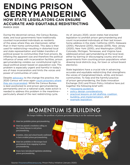
A guide to ending prison gerrymandering for state legislators. A joint effort with SiX, it includes lessons from our previous advocacy, detailed policy recommendations, talking points, and more to guide states through introducing and passing legislation.
October 27, 2026: On October 27, 2026 at 1:30 p.m. EST, join the Prison Policy Initiative for a webinar focused on making public records requests. We’ll cover the basics of making a request and provide tips and tricks we’ve learned over decades of sending requests to jails, prisons, and other agencies that can make your requests more effective.