Shorts archives

Please vote for Peter Wagner to receive the Maria Leavey Award to honor his decade of work to end prison-based gerrymandering.

by Leah Sakala, May 14, 2012

Today is the last day to cast your vote for Peter Wagner to receive the Maria Leavey Tribute Award for his decade-long work to end prison-based gerrymandering. Campaign for America’s Future presents this award annually to honor an “unsung progressive hero.”

Peter was chosen as a finalist for the award in recognition of his leadership in the movement to abolish prison-based gerrymandering. Our friend and advisory board member Bruce Reilly wrote a great blog post that explains why he voted for Peter and why you should, too.

Thanks for your support, and for sending the message that prison-based gerrymandering must end.


The Tribune Star reports that Council is considering a resolution to exclude the prison population for redistricting purposes.

by Leah Sakala, May 7, 2012

A couple of weeks ago I blogged that Terre Haute, Indiana is considering ending prison-based gerrymandering. A recent Tribune Star story reports that this week the City Council may vote on a resolution to remove the prison population from District 1 for redistricting purposes. Stay tuned for more updates!


Peter Wagner be in NYC to speak about prison-based gerrymandering on Saturday at Columbia University.

by Peter Wagner, April 26, 2012

I’ll be speaking about prison-based gerrymandering and then moderating a roundtable discussion with Students Against Mass Incarceration on Saturday at the A New Vision of Black Freedom: The Manning Marable Memorial Conference at Columbia University in New York City. My session starts at 10am in the Earl Hall Auditorium.

This conference is particularly important to me because of the role that Manning Marable played in starting the movement against prison-based gerrymandering. As I wrote when he passed away:

Manning Marable helped put what we now call prison-based gerrymandering on the map by inviting me to meetings at his Institute for Research in African-American Studies at Columbia University in 2002 and to speak at the main plenary panel at the Africana Studies Against Criminal Injustice Conference in 2003. His early endorsement made our later successes possible.

If you will be in NYC this weekend, I hope to see you at the conference and at my talk!


Our guide explaining what to look for in redistricting data in order to avoid prison-based gerrymandering is now available in Spanish.

by Leah Sakala, March 29, 2012

We are proud to report that one of our publications, “Preventing Prison-based Gerrymandering in Redistricting: What to Watch For” is now available in Spanish. This guide will tell you what to look for in redistricting data and in proposed plans in order to minimize the harm of prison-based gerrymandering.

Estamos orgullosos de anunciar que una de nuestras publicaciones, “Prevenir la manipulación de los límites de los distritos electorales sobre la base de la población reclusa: qué es lo que hay que evitar,” ahora está disponible en Español. Está guía le explicará qué es lo que hay que buscar en los datos de la redistribución de distritos para minimizar el daño de la manipulación de los límites de los distritos electorales sobre la base de la población reclusa.


by Leah Sakala, March 12, 2012

A proposed constitutional amendment in New York State would bring back prison-based gerrymandering, says redistricting expert Todd Brietbart and Common Cause of New York. City and State has the story: Democratic Expert: Redistricting Amendment Brings Back Prison-Based Gerrymandering [UPDATED]

Anna Pycior of Dēmos also weighed in: New York Redistricting Should Be Non-Partisan, Not Bi-Partisan

Anna’s piece ends:

This amendment is a scapegoat that offers little to no real reform. Being that it was only released last night, it’s too early to say what the likelihood is that it will be the “reform” promised by many legislators.


PPI signed on to a Census Project coalition letter in opposition to a recent proposal to make participation in the ACS voluntary rather than mandatory.

by Leah Sakala, March 6, 2012

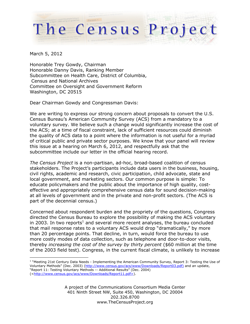
Census Project ACT letter

The Prison Policy Initiative joined more than 25 other Census Project organizations to send a letter to House congressional leaders in opposition to a recent proposal to make participation in the American Community Survey voluntary rather than mandatory.

The American Community Survey provides vital information to public and private sector decision-makers alike, and the coalition letter warns that making participation in the survey voluntary would dramatically compromise the data by decreasing the response rate and increasing the expense.

The Prison Policy Initiative typically focuses on how the Census Bureau’s method of counting people in prison in the decennial Census negatively affects the redistricting process. The expertise we developed for that project has led to a deeper appreciation for the importance of other Census Bureau data products. We’ve learned just how important the American Community Survey is, so we joined the Census Project in this important letter.

The letter concludes:

[W]e urge your subcommittee to view any proposal to make the American Community Survey voluntary with great caution. Such a change would have serious adverse consequences that could leave the nation in a precarious decision-making vacuum and hinder its economic recovery and future growth.


Ending prison-based gerrymandering in Oregon would bring the state's redistricting process in line with both the state constitution and with the federal principle of "one person, one vote."

by Leah Sakala, February 16, 2012

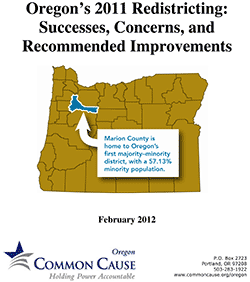
Common Cause Report Cover

A new report released by Common Cause Oregon recommends ending prison-based gerrymandering as a critical step for improving Oregon‘s redistricting process. Ending prison-based gerrymandering in Oregon would bring the state’s redistricting process in line with both the state constitution and with the federal principle of “one person, one vote.”

The report shows that prison-based gerrymandering is especially problematic for the City of Pendleton:

The City of Pendleton in Umatilla County provides an Oregon example of the negative effect on democracy of claiming incarcerated people as constituents of the prison location. The Eastern Oregon Correctional Institution is 28 percent of a Pendleton city council district, giving every 3 residents of the ward with the prison the political power of 4 residents in other parts of the city. Department of Corrections statistics show that virtually everyone incarcerated at the Eastern Oregon Correctional Institution comes from other parts of the state.

The solution is clear:

Common Cause Oregon recommends legislative action to end prison gerrymandering in 2021 by excluding prisoners in redistricting unless the Census Bureau changes its policy of counting prisoners where they are confined in its 2020 count.


Today the New York Times printed an editorial praising a Federal District Court’s decision to uphold the 2010 law that ended prison-based gerrymandering in Maryland.

by Leah Sakala, January 17, 2012
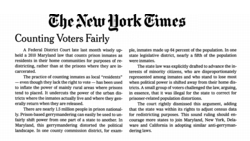
NYT thumbnail

Today the New York Times editorial board praised a Federal District Court’s decision to uphold the 2010 law that ended prison-based gerrymandering in Maryland. The law had been challenged by plaintiffs in Fletcher v. Lamone.

The editorial states:

Counting Voters Fairly

A Federal District Court late last month wisely upheld a 2010 Maryland law that counts prison inmates as residents in their home communities for purposes of redistricting, rather than at the prisons where they are incarcerated.

The practice of counting inmates as local “residents” — even though they lack the right to vote — has been used to inflate the power of mainly rural areas where prisons tend to placed. It undercuts the power of the urban districts where the inmates actually live and where they generally return when they are released.

There are about 1.5 million people in prison nationally. Prison-based gerrymandering can easily be used to unfairly shift power from one part of a state to another. In Maryland, this gerrymandering distorted the political landscape. In one county commission district, for example, inmates made up 64 percent of the population. In one state legislative district, nearly a fifth of the population were inmates.

The state law was explicitly drafted to advance the interests of minority citizens, who are disproportionately represented among inmates and who stand to lose most when political power is shifted away from their home districts. A small group of voters challenged the law, arguing, in essence, that it was illegal for the state to correct for prisoner-related population distortions.

The court rightly dismissed this argument, adding that the state was within its rights to adjust census data for redistricting purposes. This sound ruling should encourage more states to join Maryland, New York, Delaware and California in adopting similar anti-gerrymandering laws.

Case documents, related materials, and selected news coverage are available on our Fletcher v. Lamone page.
New issue of Urban Habitat's journal includes an article about how Census Bureau’s miscount of incarcerated people distorts our democracy and impedes racial justice.

by Leah Sakala, January 13, 2012

The newest issue of Race, Poverty & the Environment includes a “Geography of Race” section with an article I wrote on how the Census Bureau’s miscount of incarcerated people distorts our democracy and impedes racial justice. The Race, Poverty & the Environment journal is a project of Urban Habitat.


New York task force has released population data to be used for state and local redistricting, which counts incarcerated people at their home addresses.

by Peter Wagner, January 6, 2012

After months of public concern that the New York Senate did not intend to implement the law ending prison-based gerrymandering, last night the redistricting taskforce, LATFOR, released the population data to be used for state and local redistricting, which counts incarcerated people at their home addresses. You can download the data and the accompanying documentation on the LATFOR website.


Stay Informed


Get the latest updates:


Share on 𝕏 Donate