Legislation
State and local governments can take action on their own to end prison gerrymandering; they need not wait for the Census Bureau to change where incarcerated people are counted.
Model legislation
- Model state legislation to end prison-based gerrymandering with some guidance on how to customize for your state.
Enacted legislation
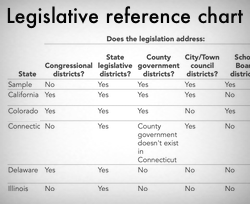 Quick-reference chart:
States' legislation ending prison gerrymandering.
This quick-reference chart helps advocates sift through the differences between states' legislative approaches to ending various aspects of prison gerrymandering.
Legislative history of enacted legislation
- California: AB 420, An act to add Section 21003 to the Elections Code, relating to redistricting, introduced by Assembly Member Davis, February 14, 2011. The bill passed the Assembly on June 1 and the Senate on August 30, and was signed by the governor on October 7, 2011. AB 420 added Section 21003 to the California Elections Code. And AB 1986, An act
to amend Section 21003 of the Elections Code, relating to
redistricting, introduced by Assembly Member Davis, amended March 29, 2012, was signed by the governor on September 14, 2012. (The bill amends AB 420, adding privacy protections and covering people incarcerated in federal facilities, a full bill analysis is available from the Assembly Committee on Elections and Redistricting.) AB 2172, An Act to Amend Section 21003 of the Elections Code, introduced by Assembly Member Weber, was signed by the governor on August 28, 2018 and included technical fixes to Section 21003. AB 849, introduced by Assembly Member Bonta and signed by the governor on October 8, 2019, required local governments to use available data to count incarcerated people at their last known place of residence. It amends the Elections Code at Section 21500 (counties) and 21601 (general law cities), and repeals and adds Section 21621 (chartered cities).
- Colorado: HB 20-1010, “Colorado Accurate Residence for Redistricting Act”, sponsored by Rep. K. Tipper and Rep. J. Coleman, filed on January 8, 2020. It passed the House on February 6, 2020 and the Senate on February 25, 2020, and was signed by the Governor on March 20, 2020. HB 20-1010 is codified in Colorado's Revised Statutes at Section 2-2-902, which was added, and at Section 2-2-901, which was amended. Senate Bill 02-007 Concerning County Commissioner Redistricting, sponsored by Senator Hillman, and Representatives Kester, Garcia, and Hoppe, and approved by the Governor on March 27, 2002, prohibits counties from using prison populations when drawing county commissioner districts. Senate Bill 02-007 was codified by amending the Colorado Revised Statutes Section 30-10-306 (1), (2), (4) and Section 30-10-306.7. Two years later, the state passed House Bill 04-1230, Concerning the Election of School District Directors from Director Districts, sponsored by representatives Hall, May M., Crane, Fairbank, Lundberg, Mitchell, Rose, Williams S., Williams T., Cadman, Garcia, Hefley, Lee, and Vigil and Senator Jones, and approved by the Governor on April 21, 2004, which prohibits school districts from using prison populations when drawing school director districts. House Bill 04-1230 was codified by amending Section 22-31-105(2) and (7)(a), Section 22-31-109, and Section 22-31-110(1)(b); and by adding Section 22-31-105(6.5).
- Connecticut: SB 753, co-sponsored by Sen. Gary A. Winfield, Sen. Derek Slap, and Rep. Patricia A. Dillon, for the January 2021 session. Drafted by the Government Administration and Elections Committee March 3, 2021. The bill passed the Senate on May 5, 2021 and the House on May 12, 2021. SB 753, signed by Governor Lamont on May 26, 2021.
- Delaware: House Bill # 384, An Act To Amend Title 29 of the Delaware Code Relating to State Government, passed unanimously by the Delaware House, June 1, 2010, and 17-3 in the Delaware Senate, June 30, 2010. Signed by the Governor August 31, 2010, Primary sponsor: Representative Keeley. Additional sponsors: Rep. J. Johnson & Rep. D.P. Williams & Sen. Henry. Cosponsors: Reps. Barbieri, Brady, Hudson, Mitchell; Sens. Marshall, McDowell. Amended May 13, 2011. HB # 384 inserted Section 804A into Title 29 of Delaware's Code. Amended by Senate Bill # 171, An Act To Amend Title 29 of the Delaware Code Relating to Counting Incarcerated Individuals for Redistricting Purposes, signed September 8, 2021.
- Illinois: HB 0203, “No Representation Without Population Act,” sponsored by Representatives LaShawn K. Ford, prefiled on December 19, 2018. The bill language was inserted as an amendment into HB 3653, a effort that was led by Rep. Justin Slaughter in the house and Senators Elgie Sims and Robert Peters in the Senate. HB 3653 passed both houses January 13, 2021, and was signed by the Governor on February 23, 2021. Article 2 of the bill, which contains the “No Representation Without Population Act,” takes effect January 1, 2025. In 2023, the Governor signed HB 1496, introduced by Representative Ford, which makes important technical amendments to the law.
- Maine: LD 1704 / HP 1093, introduced by Speaker Talbot Ross, would end prison gerrymandering in legislative redistricting. It was signed into law by Governor Janet Mills on June 30, 2023.
- Maryland: No Representation Without Population Act, introduced in the House of Delegates by Delegate Pena-Melnyk as HB496 and in the Senate by Senator Pugh as SB400, January 29, 2010. Signed by the governor, April 13, 2010. Regulations were adopted, effective February 25, 2011. HB496 and SB400 amended Maryland Election Law Section 8-701, and added Maryland State Government Law Section 2-2A-01 and Local Government Section 1-1307.
- Massachusetts: S 309 and H 3185 “Resolutions Urging the Census Bureau to Provide Redistricting Data that Counts Prisoners in a Manner Consistent with the Principles of ‘One Person, One Vote,’” sponsored by Senator Sonia Chang-Diaz and Representative Linda Dorcena Forry, respectively, introduced on January 22, 2013. The resulting joint resolution was passed by the Senate on July 31, 2014 and the House on August 14, 2014, and delivered to the Director of the Census Bureau on September 12, 2014.
- Michigan: Statutory requirements for redistricting prevent state prison populations from skewing either county (Mich. Comp. Laws § 46.404(g)) or municipal (Mich. Comp. Laws § 117.27a (5)) democracy. The statutes provide that the district population cannot include anyone in a state institution who is not a resident of the city or county for election purposes.
- Montana: SB 77: Generally revise laws related to redistricting data for inmates, introduced by Senator Morigeau by request of the Montana Districting and Apportionment Commission. Signed by the governor on on April 25, 2023.
- Nevada: AB450, “…revising the manner in which certain incarcerated persons are counted for purposes of the apportionment of the population for legislative districts, congressional districts and the districts of the Board of Regents…”, sponsored by the Assembly Committee on Legislative Operations and Elections, introduced March 25, 2019. Passed Assembly April 17, 2019 and Senate May 23, 2019, and was signed by the Governor on May 29. AB450 added Sections 218B.080 and 218B.105 to Nevada's Revised Statutes. AB450 amended Section 218B at 218B.010 and 218B.050; Section 209 at 209.131; Section 304 at 304.065 and 304.060; and Section 396 at 396.0414 and 396.031.
- New Jersey:
S758, “requir[ing] incarcerated individual from State to be counted at residential address for legislative redistricting purposes”, introduced by Senators Sandra Cunningham and Nilsa Cruz-Perez, January 9, 2018, and A1987, introduced by Assemblymembers Sumter, Mukherji, Quijano, and Pinkin, January 9, 2018. S758 passed the Senate on February 25,2019, the Assembly on January 13, 2020, and signed into law by the Governor on January 21, 2020. S758 was codified in New Jersey's Revised Statutes at Sections 52:4-1.1, 52:4-1.2, 52:4-1.3, 52:4-1.4, 52:4-1.5, and 52:4-1.6 . These laws were expanded by A698, "requiring the counting of an incarcerated individual at the individual's residential address for municipal, county, and congressional redistricting purposes and for the apportionment of regional school district board of education members, amending N.J.S.18A:13-8 and P.L.2017, c.45, and supplementing P.L.2019, c.385 (C.52:4-1.1 et seq.)," which was introduced in the Assembly on January 14, 2020. The companion bill, S3964, was introduced in the Senate on June 15, 2021. The bills passed both houses on June 30, 2021 and were signed by Governor Murphy on August 8, 2021. This law ends prison gerrymandering at the congressional, county, municipal, and school board level. Prior to 2021, New Jersey's previously enacted legislation addressed prison gerrymandering at only the state level and for some school boards.
- New York’s bill to end prison-based gerrymandering was attached as part XX of the revenue budget (A9710D/S6610C) and had a technical amendment, A11597/S8415. The Bill and the amendment passed the Assembly on July 1, and the Senate on August 3, 2010. Both were signed by the governor on August 11, 2010. Part XX of A9710D/S6610C and the amendment, A11597/S8415, were codified by amending N.Y. Correct. Law Section 71(8), adding N.Y. Legis. Law Section 83-m(13), and N.Y. Mun. Home Rule Law Section 10 (13).
- Essex County, New York: More than a hundred rural counties and municipalities around the country refuse to engage in prison-based gerrymandering when drawing their local district lines, but to our knowledge Essex County Local Law No 1 of 2003 is the only one to put their rationale directly the law’s text.
- Tennessee: the state amended its redistricting statute in 2016 to allow counties to avoid prison-based gerrymandering. The bill passed the House on April 4, and the Senate on April 11 and signed by the governor on April 27, 2016.
- Virginia: On April 22, 2020 HB 1255 (Del. Price), and SB 717 (Sen. McClellan) were enacted after the Senate and House both concurred in the Governor’s April 8, 2020 recommendations. SB 717/HB 1255 were codified by adding Sections 24.2-304.04, 24.2-314, and 53.1-52, and by amending 24.2-304.1, 30-265, and 53.1-10 of the Code of Virginia. The law ends prison gerrymandering in state and congressional districts and among counties, cities, and towns.
- Prior to the 2020 law, Virginia had previously enacted legislation addressing prison gerrymandering at the local level -- however, that earlier legislation was rendered obsolete by the passage of HB 1255/SB 717. Looking back, Virginia's law began to evolve in 2010 with HB 13, “Redistricting local districts; local government may exclude prison populations from its calculation,” prefiled by Delegate Riley E. Ingram, December 2, 2011, passed unanimously by both the House and Senate in February 2012, and signed into law by the Governor on March 23, 2012. (For our analysis of the bill, see
Virginia bill would help counties avoid prison-based gerrymandering.) Next, HB 1339, “Election districts & redistricting; locality permitted to exclude from census correctional facility,” prefiled by Delegate R. Lee Ware, Jr., November 20, 2012, passed the House unanimously on January 23, and with bipartisan support in the Senate on February 15, and was signed into law by the Governor on March 18, 2013. (For our analysis of the bill, see Virginia ends mandatory prison gerrymandering.) Both of those bills applied only to county, city or municipal redistricting (and as noted above, have been rendered obsolete by the passage of HB 1255/SB 717).
- Prior to the 2020 law, Virginia had previously enacted legislation addressing prison gerrymandering at the local level -- however, that earlier legislation was rendered obsolete by the passage of HB 1255/SB 717. Looking back, Virginia's law began to evolve in 2010 with HB 13, “Redistricting local districts; local government may exclude prison populations from its calculation,” prefiled by Delegate Riley E. Ingram, December 2, 2011, passed unanimously by both the House and Senate in February 2012, and signed into law by the Governor on March 23, 2012. (For our analysis of the bill, see Virginia bill would help counties avoid prison-based gerrymandering.) Next, HB 1339, “Election districts & redistricting; locality permitted to exclude from census correctional facility,” prefiled by Delegate R. Lee Ware, Jr., November 20, 2012, passed the House unanimously on January 23, and with bipartisan support in the Senate on February 15, and was signed into law by the Governor on March 18, 2013. (For our analysis of the bill, see Virginia ends mandatory prison gerrymandering.) Both of those bills applied only to county, city or municipal redistricting (and as noted above, have been rendered obsolete by the passage of HB 1255/SB 717).
Current bills
- Federal: H.R.2905, introduced by Rep. Deborah Ross of North Carolina, on April 26, 2023.
- Michigan: SB 494, introduced by Senator Santana on September 14, 2023.
- Minnesota: Senate and House omnibus bills on elections policy include provisions ending prison gerrymandering. (There had previously been standalone measures to end the practice — HF 4043/SF 3878 by Reps. Agbaje, Long, Frazier, Greenman, and Sens. Mitchell, Boldon, Murphy, Oumou Verbeten — which were rolled into the omnibus bills.)
- Rhode Island:, H 7070, introduced by Representatives Cruz, Ajello, Morales, Stewart, Batista, Henries, Cotter, Sanchez, Felix, and Slater, on January 5, 2024.
Efforts in previous legislative sessions:
- Rhode Island: H 5613, introduced by Representatives Cruz, Potter, Slater, Stewart, Kazarian, Batista, Morales, J. Lombardi, Cotter, and McNamara, on February 15, 2023.
- Maine: SIGNED INTO LAW LD 1704 / HP 1093, introduced by Speaker Talbot Ross, would end prison gerrymandering in legislative redistricting. It was signed into law by Governor Janet Mills on June 30, 2023.
- Oregon: HB 3216, introduced by Representative Holvey on February 9, 2023.
- Montana: SIGNED INTO LAW SB 77: Generally revise laws related to redistricting data for inmates, introduced by Senator Morigeau by request of the Montana Districting and Apportionment Commission. Signed by the governor on on April 25, 2023.
- Louisiana: HB 846, “relative to registration and voting”, filed by Representative C. Denise Marcelle, for Regular Session 2022.
- Michigan: HB 4276, introduced by Representative Anthony on February 18, 2021. And SB 151, introduced by Senator Santana on February 18, 2021.
- Pennsylvania: HB 706, An Act amending the act of June 3, 1937 (P.L.1333, No.320), known as the Pennsylvania Election Code, in election districts and polling places, providing for residence of incarcerated individuals and individuals attending a college or university living in congregate student housing, introduced by Representatives McClinton, Lee, Frankel, Hohenstein, N. Nelson, Kinsey, Hill-Evans, Sanchez, Burgos, Schlossberg, Sappey, Wheatley, Isaacson, Galloway, Cireesi, Delloso, T. Davis, Parker, Freeman, Webster, Sims, Warren, Brooks, Schweyer, Rabb, Zabel, Kinkead, Innamorato, Pisciottano, D. Williams, Madden, A. Davis, Otten, and A. Brown on December 13, 2021. SB 104, An Act amending the act of June 3, 1937 (P.L.1333, No.320), known as the Pennsylvania Election Code, in election districts and polling places, providing for residence of incarcerated individuals and individuals attending a college or university living in congregate student housing, introduced by Senators Street, Fontana, Muth, Santarsiero, Tartaglione, Blake, Costa, and Kane on January 25, 2021. HB 1424, An Act amending the act of June 3, 1937 (P.L.1333, No.320), known as the Pennsylvania Election Code, in election districts and polling places, providing for population of congressional and State legislative districts, introduced by Representatives Wheatley, Frankel, N. Nelson, Schlossberg, Zabel, Sanchez, Kinsey, Hohenstein, Hill-Evans, Ciresi, Howard, Parker, D. Williams, Webster, Sims, McClinton, Warren, Lee, and Madden on May 14, 2021.
- Rhode Island: H 7741, “Residence of Individuals in Government Custody Act”, introduced by Representatives Williams, Vella-Wilkinson, Giraldo, Felix, Ajello, Alzate, Tobon, Handy, Morales, and Batista, March 2, 2022. And S 2257, “Residence of Individuals in Government Custody Act”, introduced by Senators Quezada, Archimbault, Cano, Euer, and Murray, February 11, 2022.
- Federal: HR 1, “For the People Act,”, Sec. 2701, introduced January 4, 2021. Passed the House on March 3, 2021. And HR 6550, “End Prison Gerrymandering Act”, introduced by Rep. Ross and 14 original co-sponsors, February 1, 2022.
- Connecticut: SIGNED INTO LAW SB 753, co-sponsored by Sen. Gary A. Winfield, Sen. Derek Slap, and Rep. Patricia A. Dillon, for the January 2021 session. Drafted by the Government Administration and Elections Committee March 3, 2021. The bill passed the Senate on May 5, 2021 and the House on May 12, 2021. SB 753, signed by Governor Lamont on May 26, 2021. And SB 155, introduced by Sen. Will Haskell and Rep. Quentin W. Phipps, for the January 2021 session.
- Delaware: Senate Bill 171, introduced by Senator Sokola on June 4, 2021 and passed both houses on June 24, 2021. This bill is ready for the governor's signature.
- Missouri: HB 1623, prefiled by Representative Alan Gray on December 6, 2019 and SB 191, prefiled by Senator Barbara Anne Washington on December 1, 2020.
- New Jersey: SIGNED INTO LAW A698, " requiring the counting of an incarcerated individual at the individual's residential address for municipal, county, and congressional redistricting purposes and for the apportionment of regional school district board of education members, amending N.J.S.18A:13-8 and P.L.2017, c.45, and supplementing P.L.2019, c.385 (C.52:4-1.1 et seq.)," was introduced in the Assembly on January 14, 2020. The companion bill, S3964, was introduced in the Senate on June 15, 2021. The bills passed both houses on June 30, 2021 and were signed by Governor Murphy on August 8, 2021. This law ends prison gerrymandering at the congressional, county, municipal, and school board level.
- Rhode Island: H 5285, “Residence of Those in Government Custody Act”, introduced by Representatives Williams, Vella-Wilkinson, Knight, Slater, Felix, and Potter, January 29 2021. And S 334, “Residence of Those in Government Custody Act”, introduced by Senators Quezada, and Calkin, February 23, 2021.
- Illinois: SIGNED INTO LAW HB 0203, “No Representation Without Population Act,” sponsored by Representatives LaShawn K. Ford, prefiled on December 19, 2018. The bill language was inserted as an amendment into HB 3653, which passed both houses January 13, 2021, and was signed by the Governor on February 23, 2021.
- Colorado: SIGNED INTO LAW HB 20-1010, “Colorado Accurate Residence for Redistricting Act”, sponsored by Rep. K. Tipper and Rep. J. Coleman, filed on January 8, 2020. Passed the House on February 6, 2020 and the Senate on February 25, 2020, and was signed by the Governor on March 20, 2020.
- Connecticut: SB 368, introduced by the Government Administration and Elections Committee for the February Session, 2020.
- Florida: SB 268, “Decennial Census; Requiring the Legislature to adjust federal decennial census figures to include prisoners in the geographic areas where they last resided before incarceration rather than the facility where they resided at the time of the federal census…”, filed by Senator Randolph Bracy on September 12, 2019.
- Louisiana: HB 625, “relative to the allocation of incarcerated persons for the purposes of all redistricting by the legislature”, prefiled by Representative Edward Ted James, February 28, 2020.
- Michigan: SB 759, introduced by Senator Santana on January 28, 2020.
- Minnesota: HF 3493, introduced by Representatives Long, Noor, Stephenson, Moller, Howard, Wazlawik, Davnie, Edelson, Elkins, Hornstein, Lippert, Bierman, Sandell, Bahner, Vang, Jordan, Lee, Freiberg, Schultz, Dehn, Pinto, and Lieblingon on February 18, 2020.
- Nebraska: LB 1157, “to provide for counting Nebraska residents confined to prison in Nebraska as prescribed” introduced by Senator Vargas on January 22, 2020.
- Pennsylvania: HB 940 An act… “providing for residence of incarcerated individuals”, introduced by Representatives McClinton, Schlossberg, Millard, Hill-Evans, Kinsey, Burgos, Bullock, Warren, Neilson, Fiedler, Kenyatta,Youngblood, Irvin, and Webster, March 25, 2019.
- Rhode Island: H 5513, “Residence of Those in Government Custody Act”, introduced by Representatives Williams, Vella-Wilkinson, Craven, Caldwell, and Almeida, February 14, 2019. And S 232, “Residence of Those in Government Custody Act”, introduced by Senators Metts, Nesselbush, Quezada, Cano, and Crowley, January 31, 2019.
- Virginia: SIGNED INTO LAW On April 22, 2020 HB 1255 (Del. Price), and SB 717 (Sen. McClellan) were enacted after the Senate and House both concurred in the Governor’s April 8, 2020 recommendations. Additionally,SB 516, “Redistricting; population data, reallocation of prison populations”, prefiled by Senator John Edwards on January 7, 2020, and HB 319 prefiled by Delegate Mark Levine on December 31, 2019. And HB 1254, “Redistricting; population data, reallocation of prison populations” introduced by Delegate Marcia Price as chief patron, with Delegates Patrick Hope, Joseph Lindsey, and Sam Rasoul co-patrons, prefiled on January 8, 2020. Provisions to end prison gerrymandering are also included in the following broader redistricting criteria and redistricting commission bills: HB 1255 (Del. Price), SB 717 (Sen. McClellan), HB 1256 (Del. Price), HB 758 (Del. VanValkenburg), and SB 203 (Sen. Lucas).
- Wisconsin: AB 400, relating to counting individuals confined in state prison to determine population for redistricting purposes, introduced by Representatives Crowley, Emerson, Anderson, Bowen, Brostoff, Cabrera, Fields, Goyke, Hebl, L. Myers, Neubauer, Ohnstad, Sargent, Spreitzer, Subeck, C. Taylor and Zamarripa; and cosponsored by Senators L. Taylor, Bewley, Carpenter, Johnson, Larson, Risser and Smith, September 5, 2019.
- Federal: H.R.3645, “Correct the Census Count Act,” sponsored by Representative Clay, introduced on July 9, 2019 and S.3481, “…to provide that individuals in prison shall, for the purposes of a decennial census, be attributed to the last place of residence before incarceration” sponsored by Senator Merkley, introduced on March 12, 2020; and HR 1, “For the People Act,” prison gerrymandering amendment offered by Representative Pocan, agreed to on March 7, 2019 and HR 1 passed the House on March 8, 2019.
- Missouri: HB 1623, introduced by Representative Alan Gray on December 6, 2019.
- Oregon: HB 2492, “Relating to redistricting”, has chief sponsors Representative Holvey and Senator Prozanski and regular sponsors Representatives Nosse, Piluso, Sanchez, filed on January 14, 2019.
- Connecticut:HB 5611, introduced by the Government Administration and Elections Committee for the January Session, 2019.
- Louisiana: HB 46, “relative to the allocation of incarcerated persons for the purposes of all redistricting by the legislature”, prefiled by Representative Bouie, March 7, 2019.
- Texas: “An Act Relating to the inclusion of an incarcerated person in the population data used for redistricting according to the person’s last residence before incarceration” was filed by Representative Johnson as HB 104 on November 12, 2018.
- Nevada: SIGNED INTO LAW: May 29, 2019. AB450, “…revising the manner in which certain incarcerated persons are counted for purposes of the apportionment of the population for legislative districts, congressional districts and the districts of the Board of Regents…”, sponsored by the Assembly Committee on Legislative Operations and Elections, introduced March 25, 2019.
- New Jersey: SIGNED INTO LAW: January 21, 2020. S758, “requir[ing] incarcerated individual from State to be counted at residential address for legislative redistricting purposes”, introduced by Senators Sandra Cunningham and Nilsa Cruz-Perez, January 9, 2018, and A1987, introduced by Assemblymembers Sumter, Mukherji, Quijano, and Pinkin, January 9, 2018. S758 passed the Senate on February 25,2019, the Assembly on January 13, 2020, and signed into law by the Governor on January 21, 2020.
- Washington: SIGNED INTO LAW: May 21, 2019. “Ensuring accurate redistricting”, SB 5287, sponsored by Senators Darneille and Hunt, introduced on January 17, 2019.
- Rhode Island: H 7530, “Residence of Those in Government Custody Act”, introduced by Representatives Williams, Ajello, Ranglin Vassell, Perez, and Slater, February 9, 2018. And S 2267, “Residence of Those in Government Custody Act”, introduced by Senators Metts, Jabour, Quezada, Crowley, and Nesselbush, February 01, 2018.
- Illinois: HB 0205, “No Representation Without Population Act,” sponsored by Representatives LaShawn K. Ford, prefiled on December 5, 2016.
- Louisiana: HB 89, prefiled by Representative Smith, February 20, 2018.
- Rhode Island: H 5309, “Residence of Those in Government Custody Act”, introduced by Representatives Williams, Slater, Ajello, Cunha, and Lombardi, February 1, 2017. And S 0344, “Residence of Those in Government Custody Act”, introduced by Senators Metts, Jabour, Quezada, Crowley, and Nesselbush, February 16, 2017.
- New Jersey: S587, “requir[ing] incarcerated individual from State to be counted at residential address for legislative redistricting purposes”, introduced by Senator Sandra Cunningham, January 1, 2016 (passed the Senate on November 14,2016), and A2937, introduced by Assemblywoman Shavonda Sumter, February 16, 2016; and A3292, introduced by Assemblymembers Wimberly, Barclay, Eustace, Oliver, Spencer, and Tucker, February 22, 2016. S587 passed both chambers but was vetoed by the Governor.
- Texas: “An Act Relating to the inclusion of an incarcerated person in the population data used for redistricting according to the person’s last residence before incarceration” was filed by Representative Johnson as HB 1215 on January 23, 2017.
- Louisiana: HB 228, prefiled by Representative Smith, March 29, 2017.
- Connecticut:SB 459, introduced by the Judiciary Committee for the February Session, 2016.
- Rhode Island: H 7400, “Residence of Those in Government Custody Act”, introduced by Representatives Williams, Regunberg, Ajello, Costa, and Lombardi, January 28, 2016. And S 2310, “Residence of Those in Government Custody Act”, introduced by Senators Metts, Crowley, Jabour, Pichardo, and Doyle, February 9, 2016.
- Illinois: HB 1489, “No Representation Without Population Act,” cosponsored by Representatives LaShawn K. Ford, Mary E. Flowers, Eddie Lee Jackson, Sr., Camille Y. Lilly, Jehan A. Gordon-Booth, Emanuel Chris Welch, Carol Ammons, Kenneth Dunkin and Arthur Turner, filed on February 5, 2015.
- Tennessee: HB 752, “Prison Gerrymandering Reform Act”, introduced by Representative Camper, February 11, 2015 and SB 1212, “Prison Gerrymandering Reform Act”, introduced by Senator Yarbro, February 12, 2015. And HB 302, “No Representation Without Population Act of 2015”, introduced by Representative Favors, February 4, 2015, and SB 1075, “No Representation Without Population Act of 2015”, introduced by Senator Harris, February 12, 2015.
- Minnesota: HF 1189, authored by Representatives R. Dehn, Atkins, Mariani, Schoen, Moran, and Clark, February 25, 2015; and SF 1151, authored by Senators Hayden, B. Petersen, Rest, and Hoffman, February 26, 2015. Provisions ending prison gerrymandering are also included as Article 6 of the Senate’s elections omnibus reform bill, SF 455, which passed the Senate on May 11, 2015.
- Oregon: SB 331, sponsored by Senator Shields, Representative Parrish, and Representative Frederick as chief sponsors and Senator Beyer and Senator Edwards as regular sponsors, precession filed for the 2015 regular session.
- Rhode Island: H 5155, “Residence of Those in Government Custody Act”, introduced by Representative Anastasia P. Williams, January 21, 2015. And S 0239, “Residence of Those in Government Custody Act”, introduced by Senators Metts, Crowley, Jabour, Nesselbush, and Pichardo, February 11, 2015.
- New Jersey: S480, “requir[ing] incarcerated individual from State to be counted at residential address for legislative redistricting purposes”, introduced by Senator Sandra Cunningham, January 14, 2014; and A659, introduced by Assemblymembers Cryan, Wisniewski, Oliver, and Quijano.
- Federal: HR 1537, “To amend title 13, United States Code, to provide that individuals in prison shall, for the purposes of a decennial census, be attributed to the last place of residence before incarceration,” introduced by Representatives Jeffries (NY), Richmond (LA), Rangel (NY), Johnson (GA), Clarke (NY), Scott (VA) on April 12, 2013.
- Virginia: SB 765, “Redistricting; certain population data to be used” introduced by Senator John Edwards as chief patron, with Senator Janet Howell as co-patron, prefiled on December 23, 2014. And HB 1465, “Population data to be used in redistricting” introduced by Delegate Sam Rasoul as chief patron, with Delegate David B. Albo as chief co-patron, and Delegate Patrick A. Hope as patron, prefiled on December 30, 2014.
- Illinois: HB 62, “No Representation Without Population Act,” prefiled by Rep. LaShawn K. Ford, January 3, 2013. The bill passed the House on May 15, 2013.
- Rhode Island: “The Residence of Those in Government Custody Act,” introduced as S 2286 by Senators Metts, Crowley, Pichardo, and Jabour on February 4, 2014, and as H 7263 by Representatives Williams, Tanzi, Slater, Diaz, and Palangio, on January 30, 2014.
- Connecticut: HB 5518, “An Act Concerning the Determination of Residence for Incarcerated Persons,” introduced by Rep. Gary Holder-Winfield, January 22, 2013; HB 6679, “An Act Concerning the Counting of Incarcerated Persons for Purposes of Determining Legislative Districts and Distributing State and Federal Funds,” introduced by the Judiciary Committee, March 25, 2013.
- Oregon: SB 516, sponsored by the committee on General Government, Consumer And Small Business Protection, and HB 2686, sponsored by Representatives Berger and Bailey, both introduced in the 2013 Regular Session.
- Rhode Island: “The Residence of Those in Government Custody Act,” introduced as S 0147 by Senators Metts, Crowley, Pichardo, and Jabour on January 24, 2013, and as H 5283 by Representatives Williams, Lally, Guthrie, Hull, and Ajello, on February 6, 2013.
- Texas: “An Act Relating to the inclusion of an incarcerated person in the population data used for redistricting according to the person’s last residence before incarceration” was filed by Representative Dutton as HB 329 on December 21, 2012, and Representative Johnson as HB 684 on January 24, 2013.
- Kentucky: BR 219, “An act relating to information used in redistricting”, pre-filed by Representative Darryl T. Owens, October 25, 2012.
- New Jersey: S1055, “requir[ing] incarcerated individual from State to be counted at residential address for legislative redistricting purposes”, introduced by Senator Sandra Cunningham, January, 2012; and A1437, introduced by Assemblymembers Watson Coleman and Coutinho.
- Rhode Island: H 7090 Residence of Those in Government Custody Act, introduced by Representatives Williams, Cimini, Handy, Slater, and McCauley, January 11, 2012 and S 2218, introduced by Senators Metts, and Pichardo, January 24, 2012.
- Arkansas: HB1996 To Clarify County Population for Apportionment Purposes; To Require the Department of Correction to Collect and Maintain Residential Address Information for Incarcerated Persons, introduced by Rep. Andrea Lea, March 4, 2011; HB2102 To Clarify County Population for Apportionment Purposes, to Require the Department of Corrections to Collect and Maintain Residential Address Information for Incarcerated Persons, to Clarify the Distribution of Funds to Counties, introduced by Rep. Andrea Lea, March 7, 2011; Resolution HR1024 To Urge the United States Census Bureau to Provide Redistricting Data that Counts Prisoners in a Manner Consistent with the Principles of “One Person, One Vote”, introduced by Rep. Andrea Lea, March 7, 2011
- Connecticut: HB6606, An Act Concerning the Determination of the Residence of Incarcerated Persons for Purposes of Legislative Redistricting, introduced March 16, 2011
- Georgia: HB 163 To provide for the inclusion and exclusion of certain prisoners in population counts when redistricting plans are created, sponsored by Representatives Dawkins-Haigler, Mayo, Beasley-Teague, Stephenson, Heard and Stephens, February 2, 2011
- Indiana: House Bill 1459 Residence of incarcerated persons, introduced by Rep. C. Brown, January 20, 2011
- Illinois: HB94 Prisoner Census Addresses, introduced by Rep. LaShawn K. Ford, January 12, 2011
- Oregon: Senate Bill 720, Relating to redistricting, February 15, 2011
- Rhode Island: Senate Bill 0340, Senators Metts, Pichardo, Jabour, Goodwin, and Perry, February 16, 2011
- Texas: HB 1227, Relating to the inclusion of an incarcerated person in the population data used for redistricting according to the person’s last residence before incarceration, introduced by Representative Dutton, February 9, 2011.
- Virginia: HB 2073 Redistricting local districts; local government may exclude from its calculations, introduced by Delegate Riley E. Ingram, January 12, 2011. it passed the House, 99-0 on February 8, 2011, but was passed over in the Senate.
- Kentucky: HB 484, AN ACT relating to information used in redistricting, introduced by Representative D. Owens, February 14, 2011
- New York: S6725A, AN ACT to amend the correction law, the legislative law, and the municipal home rule law, in relation to the collection of census data, with Sponsor’s Memo, introduced by New York State Senator Eric T. Schneiderman, February 1, 2010 and A9834A introduced by New York State Assemblymember Jeffries, and co-sponsored by Assemblymembers Espaillat, Dinowitz, Arroyo, Rivera P, Heastie, Lavine, Benjamin, Kavanagh, Kellner, Boyland, Clark, Crespo, Glick, Hooper, Latimer, Peoples-Stokes, Perry, Rosenthal, Stirpe, and Towns.
- Federal: Rep Gene Green (D, TX) has introduced a bill that would require the U.S. Census, starting with the 2020 Census, to count incarcerated people as residents of their pre-incarceration addresses: H.R. 2075, April 23, 2009
- Rhode Island: Residence of Those in Government Custody Act [PDF] (H7833), introduced by Representative Joseph S. Almeida, February 25, 2010 and S2452 [PDF] introduced by Senators Metts, Jabour, Pichardo, Goodwin, and Perry, February 11, 2010
- Connecticut: General Assembly Bill No. 5523
- Florida: Senate 1386 introduced by Senator Bullard on January 26, 2010
- Illinois: Prisoner Census Adjustment Act introduced by Rep. LaShawn K. Ford, October 14, 2009
- Minnesota: An act relating to redistricting; requiring the exclusion of persons incarcerated in state or federal correctional facilities from population counts used for state and local redistricting, introduced by Senator Higgins, March 2010: S.F. No. 3097 and H.F. 3536 introduced by Rep. Champion
- Pennsylvania: A Resolution urging the United States Census Bureau to change its policy of recording the residence of incarcerated persons from the location of the correctional facilities to the last known home address of such persons, introduced by Representatives Cruz, Youngblood, Parker and Siptroth, January 20, 2010
- Wisconsin: Census Correction Amendment [PDF] to require that incarcerated people be excluded from the population base used for redistricting legislative, county, and other districts. Introduced by Representatives Kessler, Black, Grigsby, Turner and A. Williams, cosponsored by Senator Taylor, June 22, 2009.
- Oregon: Senate Bill 1028, sponsored by Senator Shields; Senator Rosenbaum, Representatives Holvey, Kahl, Kotek, February 1, 2010
- New York: S1633 introduced by New York State Senator Eric T. Schneiderman and Senators Breslin, Diaz, Dilan, Duane, Hassell-Thompson, Krueger, Montgomery, Onorato, Oppenheimer, Parker, Sampson, Savino, Serrano, Stavisky and Thompson An Act to amend the election law, in relation to the residential classification of certain incarcerated persons February 3, 2009, and A9380 introduced by Assemblymember Jeffries, and co-sponsored by Assemblymembers Espaillat, Dinowitz, Arroyo, Rivera P, Heastie, Lavine, Benjamin, Kavanagh, Kellner, Boyland, Clark, Crespo, Glick, Hooper, Latimer, Peoples-Stokes, Perry, Rosenthal, Stirpe, and Towns.
- Oregon: H2930, introduced by Representative Shields (D, Oregon); Representatives Bruun, Freeman, Greenlick, Kahl, J Smith, directing the Department of Corrections to collect home address information so the legislature can draw districts with inmates counted at their home addresses [PDF], audio from hearing, (.ram file, start at minute 28) March 2009
- Texas: Acts relating to the inclusion of an incarcerated person in the population data used for redistricting according to the person’s last residence before incarceration. HB 672 introduced by Rep. Hodge in January 2009, and HB2855 introduced by Rep. Dutton, March 2009.
- Pennsylvania: H525 introduced by Pennsylvania Reps. Cruz, Youngblood, Myers, Wheatley, Caltagirone, Parker, Josephs, Swanger and James, Urging the United States Census Bureau to change its policy of recording the residence of incarcerated persons from the location of the correctional facilities to the last known home address of such persons , December 6, 2007 [PDF].
- Michigan: HB No 4935 introduced by Michigan Reps. Lemmons, Young and Gonzales A bill to require state and local governmental bodies to use census figures adjusted to reflect preincarceration addresses of persons imprisoned in this state June 19, 2007
- New York: S1934 introduced by New York State Senator Eric T. Schneiderman, An Act to amend the election law, in relation to the residential classification of certain incarcerated persons January 29, 2007
- New York: S2754 introduced by New York State Senator Eric T. Schneiderman An Act to amend the election law, in relation to the residential classification of certain incarcerated persons February 25, 2005
- Illinois: HB 906 introduced by Illinois Representative Arthur Turner Prisoner Census Adjustment Act February 2, 2005
- Illinois: HB 7338 introduced by Illinois Representative Arthur Turner Prisoner Census Adjustment Act October 22, 2004. Bill text
- Texas: H.B. No. 2639 drafted by Texas Representative Dutton An act relating to the inclusion of an incarcerated person in the population data used for redistricting according to the person’s last residence before incarceration. (2001)
See all past legislative proposals to end prison gerrymandering
Recommended Reading:

About the Prison Policy Initiative
Learn more about the organization behind the Prison Gerrymandering Project.

In prisons, Blacks and Latinos do the time while Whites get the jobs
We explore the racial disparity inside prisons.

Rome NY ends prison gerrymandering, Census Bureau can do better
Rome finally corrected the problem of prison gerrymandering within its borders; other cities and counties need the Census Bureau's help.

Prison-based gerrymandering's historical precedent
This is not the first time a policy barred people of color from the polls and transferred their political power to white voters.