Prison Populations and the Census — FAQ
- Table of contents
- Introduction
- Census
- Redistricting
- Impact on funding
- Data
Last update: March 25, 2024
Introduction
- Q: I don't know anything, where do I start?
- A: Start with our guide to the resources on this website, because it's a quick reference sheet to help you find the right starting point for you.
- Q: How many states have ended prison gerrymandering?
- A: There are 11 states that have passed legislation prohibiting prison gerrymandering in state legislative districts. Maryland and New York's laws changed the 2011 redistricting, and California, Colorado, Connecticut, Delaware, Nevada, New Jersey, Virginia, and Washington State's laws came into effect for the 2020 redistricting cycle. Illinois, will roll out their implementation in time for 2030. In Pennsylvania, Rhode Island, and Montana, the Legislative Redistricting Commissions counted people at home of their own initiative to avoid prison gerrymandering for the 2020 redistricting cycle.
Additionally, 2 other states (Michigan and Tennessee) have laws that apply to local government redistricting, but not state districts.
This quick reference chart sorts it all out.
Census
- Q: Does the census count incarcerated people as if they were residents of the towns where they are incarcerated?
- A: Yes.
- Q: How does the Census count incarcerated people?
- A: The Census sends forms to every American household with the question "How many people were living or staying in this house, apartment, or mobile home on April 1, 2020?" The form instructs respondents to exclude certain residents, including household members incarcerated in correctional facilities. To count incarcerated people, census takers visit prisons and distribute forms or collect the necessary data from administrators. Regardless of how their forms are filled out, the Census assigns incarcerated people to the address of the prison.
- Q: Have incarcerated people always been counted at the prison?
- A: Yes. However, until the era of mass incarceration, the Bureau's practice amounted to little more than a trivial quirk. (If fact, the Census Bureau didn't mention incarcerated people in the printed instructions prior to the 1990 Census because incarceration was still rare enough that it didn't matter.)
- Q: Are people incarcerated in federal prisons counted the same way?
- A: Yes, even though people under the jurisdiction of the Federal Bureau of Prisons are often incarcerated out of state, they are still counted at the location of the prison, not at at their address of residence.
- Q: Why does the Census need to issue rules on where to count people?
- A: The Census is trying to be sure it counts everyone, and only counts them once. To ensure consistency, the Bureau has developed the "usual residence rule."
- Q: What is the "usual residence rule"?
- A: The "usual residence rule" is how the Census Bureau determines where people should be counted.
"The U.S. Census Bureau is committed to counting every person in the 2020 Census once, only once, and in the right place."
Source: Census Bureau "Residence Criteria and Residence Situations for the 2020 Census of the United States".
- Q: What does the usual residence rule mean?
- A: In general, it means that people will be counted where they "eat and sleep most of the time." For example, people on business trips on Census Day will still be counted at home. For most people the rule is obvious, but its application is more complex for others. And for some groups — like incarcerated people, who live in a place temporarily and involuntarily — it deviates from any other standard for residence.
- Q: Is "usual residence" the same as a legal or voting residence?
- A: No. "Usual residence" is the Census' internal definition of residence. The Census Bureau collects and publishes data based on its own definition of residence, but then states use this data as if it reflected people's actual residence.
Most states define legal residence as the place that you choose to be until you intend to go somewhere else. Many state constitutions — Arizona, Colorado, Michigan, Minnesota, Missouri, Nevada, New York, Oregon, and Washington — specifically declare that incarceration does not change a residence. Most other states have this definition codified in their statutes.
The mismatch between the Bureau's "usual residence" and the traditional definitions of residence is precisely why states (and local governments across the county) are finding the data unsuitable for redistricting and are taking it upon themselves to adjust the data for use in redistricting. - Q: Besides state constitutions and voting rights law, what do definitions of residence in other contexts say about the actual residence of people in prison?
- A: Most states have constitutional clauses or statutes that define residence for incarcerated people to be the place they lived prior to incarceration. Similar rules exist in other contexts, such as determining where a person may file a lawsuit. Judge Wade H. McCree most clearly summarized the rule and its rationale in a 1973 decision:
It makes eminent good sense to say as a matter of law that one who is in a place solely by virtue of superior force exerted by another should not be held to have abandoned his former domicile. The rule shields an unwilling sojourner from the loss of rights and privileges incident to his citizenship in a particular place....
Stifel v. Hopkins 477 F.2d 1116, 1121 (1973).
- Q: Even though incarceration does not legally change someone's permanent residence, don't many people go to prison for life, and become in effect, residents of the community where the prison is located?
- A: Actually, most people in prison are serving only short sentences. Most are only away from their homes and communities temporarily, for less than 3 years. In Rhode Island for example, recent analysis showed that nearly half of the people held in the state's correctional facilities were either not yet sentenced or sentenced to less than a year. And an even shorter time is spent at any given facility, for example, in New York State, the median time served in the current facility is less than 7 months. During their relatively short term of incarceration, in nearly all respects the person remains a member of his or her home community; incarcerated people do not generally establish ties and become integrated with the community where the prison is located.
- Q: Does the "usual residence rule" require incarcerated people to be counted at the facility and not at home?
- A: The Census justifies counting incarcerated people at the prison with the usual residence rule. The Census incorrectly assumes that incarcerated people "eat and sleep most of the time" at the location of the prison, but data confirm what most impacted folks already know; that people who are in a correctional facility on Census day are not there "most of the time". For example, in Rhode Island even people already sentenced (not merely awaiting trial) generally serve only 99 days.
- Q: For what groups has the usual residence rule been changed?
- A: It's been changed for college students, missionaries, and overseas Americans and other groups, and often more than once.
- Q: How could the Census count incarcerated people differently?
- A: The Census could allow incarcerated people to declare their own addresses, or use Department of Corrections' files to determine their homes of record. The Census has used both methods successfully to count military personnel.
- Q: I heard that it would cost the Census $250 million to count incarcerated people at home, is that right?
- A: That is extremely unlikely. (The Maryland Department of Legislative Services, for example, estimates the cost of counting incarcerated people at their residential address to about $1.60 each, that would be about $4.2 million for the whole US prison population.)
So where does the $250 million figure come from?
It comes from a report the Census Bureau prepared for Congress in 2006: Tabulating Prisoners at Their "Permanent Home of Record" Address; Congress asked the Bureau for its opinion on changing the prison count, and rather than describe the problem and ask for help resolving it, the Bureau threw up a smokescreen. The New York Times was blunt: "The Census Bureau tends to stamp its feet and shake its head no when asked to do things differently than it has in the past." The editorial board neatly summarized the Bureau's report as "obtuse and evasive".
The inflated figure is the most often cited piece of the report, but the Bureau provides no breakdown of the costs. Worse, in the interest of stopping reform, the Bureau inflates minor methodological issues into unnecessary work. For example, assuming that every incarcerated person would have to be individually interviewed in a private room, creating all kinds of unnecessary expenses. - Q: Why does the Census count incarcerated people if they can't vote?
- A: The Census counts everybody, including children and non-citizens, neither of whom can vote.
Everyone has the right to equal representation, whether they can vote or not. Therefore, not only should incarcerated people be counted, they should be counted in the right place. - Q: If incarcerated people could vote, would they vote at home or prison?
- A: They would vote by absentee ballot cast in their home district. The two states that allow incarcerated people to vote (Maine and Vermont), require them to vote by absentee ballot; states that have only recently disenfranchised incarcerated people (Massachusetts and Utah), also required the same absentee voting procedure. Most states also have constitutional provisions stating that incarceration does not add or change a residence for voting purposes. (For more information, see Absentee Prisoner Voting in Maine and Vermont.)
Additionally, people in jail often still have the right to vote, people in jail are required to vote absentee using their residential address. - Q: What about college students?
- A: College students are counted at their colleges, but prior to the 1950 Census, they were counted at home. Students in boarding schools below the college level are still counted at home.
- Q: How are students different from incarcerated people? If we change how incarcerated people are counted, wouldn't we also need to change how we count students?
- A: Changing how incarcerated people are counted would not require a change in how students are counted. Students are welcome and encouraged to purchase local goods and services and to rent apartments in town. They can register to vote in the community and may decide to stay after graduation. While the majority of students will eventually leave their college towns, there is no evidence to suggest that they are likely to return to their parents' communities. For the duration of their time at the college, the college is the place they willingly live: that's the very definition of residence.
Unlike college students, incarcerated people are not a part of the local community, and while some colleges are partially self-reliant communities, prisons are entirely so. Incarcerated people are barred from leaving the facility without official permission and cannot take part in local elections. Most return to their home communities after release, as parole regulations frequently require incarcerated people to return to their county of conviction. - Q: Since incarcerated people can't vote, who suffers when districts are drawn based on prison populations?
- A: Counting prison populations as if they were actual constituents of the prison location gives a few small communities more political power at the expense of everyone who does not live near a prison. In effect, everyone who does not live in a district that contains a prison has their vote diluted by these artificially inflated populations.
In fact, prison gerrymandering is most dramatic in rural, low-population communities that host a prison; there the phantom prison population can account for most of local government district. - Q: If the Census has counted incarcerated people this way since 1790, why should it change?
- A: The Census Bureau's mission and American demographics have changed drastically in the 233 years since the first Census, and the Census has evolved in response to many of these changes. The Census' original mission was to count the number of people in each state for purposes of Congressional apportionment. It only mattered how many people New York had compared to Pennsylvania, not whether the Census Bureau counted New Yorkers at Attica Prison or in the Bronx.
Times have changed. Not only has the incarceration rate quadrupled since 1980, the Census Bureau's purpose has broadened considerably. A series of Supreme Court cases in the 1960s established the "one person, one vote" rule, which requires states and localities to redistrict at least once per decade to match evolving population patterns. The Bureau now provides state and local information suitable for use in local redistricting, as well as the data for all kinds of government planning.
Census policy is not fixed; instead it responds to changing needs. When evolving demographics meant more college students studying far from home and more Americans living overseas, Census policy changed in order to more accurately reflect Americans' diverse residences. Today, the growth in the prisoner population requires the Census to update its methodology again. - Q: The Census announced it was helping states adjust their 2020 redistricting data. What exactly is the Census doing?
- A: The Census Bureau will help make some states' home address data compatible with the Census' redistricting data by providing special access to its "Census Geocoder" tool. The Census Bureau is continuing to count incarcerated people at the location of the prison rather than at their home address, but 10 states will be redistricting based on data that counts incarcerated people at home. In order to do this adjustment, the states first need to know 1) where to find all of the incarcerated people in the Census data, and 2) what everyone's home address is, and 3) where those home addresses are located in the Census data. The Census Bureau will help with steps #1 & #3.
The Census Bureau will not do the actual data adjustment for the states, but the geocoder will allow states to verify where the Census counted their prison populations, and each state will be able to provide a list of home addresses and receive those addresses back in a format that makes them compatible with the baseline redistricting data published by the Census Bureau. This additional resource from the Census Bureau will make it easier for states to do their own data adjustment.
Redistricting
- Q: Where can I learn more about redistricting and the census?
- A: The Census Bureau has an excellent 12 page overview: Strength in Numbers: A Guide to the 2020 Census Redistricting Data From the U.S. Census Bureau [PDF]. The first half is an introduction to the Census Bureau and its role in redistricting, and the second half explains the use of the data.
We've also written few explainers:- Redistricting Matters: Small changes in the boundary lines mean huge electoral effects is a theoretical introduction to the topic that uses some simple illustrations to demonstrate why redistricting matters.
- Hanging in the balance? is about New York State Senate district 34, a Westchester county district that uses Bronx county residents to meet population requirements, against the dictates of the New York state constitution. It explains how the transfer of incarcerated people can change the outcome of elections on the border between different regions of the state.
- Primer for reporters on redistricting & prison-based gerrymandering [PDF], an introduction to prison gerrymandering issues in the local government.
And for a more general overview of redistricting, we suggest the Brennan Center's A Media Guide to Redistricting, which provides an accessible and thorough introduction to a number of redistricting topics. - Q: Hasn't this been litigated?
- A:Yes. Maryland and New York both implemented their respective laws adjusting the Census Bureau's data to count incarcerated people at home for redistricting purposes after the 2010 Census. Both states were challenged, but the courts upheld their practice of improving the Census' data. New York's law was upheld in state court (Little v New York State Task Force on Demographic Research and Reapportionment) and Maryland's law was affirmed by the U.S. Supreme Court in Fletcher v. Lamone.
While states must redistrict on the basis of actual population, the U.S. Constitution does not require states to use the federal census for its own redistricting:"Although a state is entitled to the number of representatives in the House of Representatives as determined by the federal census, it is not required to use these census figures as a basis for apportioning its own legislature." Bethel Park v. Stans, 449 F.2d 575, 583 (3rd Cir. 1971)
States are therefore free to use their own census or to correct how the federal census counts incarcerated people. In fact, making adjustments is quite common. - Q: Hasn't legislation already fixed this?
- Generally, no. More than a dozen states and over 200 local governments have taken an ad hoc approach through a mix of legislative and executive action to end prison gerrymandering, and individual legislative efforts continue while we wait for a comprehensive nation-wide solution from the Census Bureau.
- Q: How does adjusting redistricting data work in practice?
- A Demos report, Implementing Reform: How Maryland & New York Ended Prison Gerrymandering provides detailed information about the specific steps Maryland and New York took to implement these new laws based on the 2010 census in conjunction with their redistricting schedules. It details the challenges each state faced as the first in the country to implement this reform "including legal disputes and data deficiencies" and the steps taken to meet and overcome those challenges. It also provides concrete recommendations, based on the experience and expertise of the actors in each state, to assist other jurisdictions in permanently ending prison gerrymandering..
- Q: Why does most legislation ending prison gerrymandering only address prisons and not jails or other types of facilities?
- Generally, state prisons account for the most significant prison gerrymandering problems and are the most likely to maintain information systems that collect the data needed to count incarcerated people at their home address. States considering legislation to end prison gerrymandering should consider all types of facilities and determine the scope appropriate for that state's unique circumstance.
- Q: Is ending prison gerrymandering a partisan issue?
- A: No. Many legislators realize that ending prison gerrymandering is a question of electoral fairness and redistricting policy. For example, the Maryland law passed with bipartisan, urban and rural support, and the Delaware bill passed with bipartisan support in the Senate and unanimous support in the state House.
- Q: Is ending prison gerrymandering an urban vs rural issue?
- A: No. While prisons tend to prop up the population of a few (usually rural) state legislative districts in a state, incarcerated people come from all over the state, including from many other rural areas. Ending prison gerrymandering benefits residents of nearly all districts, both urban and rural.
- Q: What is Gerrymandering?
-
A: "Since a single party usually controls each state legislature, it is in the best interest of the party in power to redistrict their state so that their party will have more seats ... than the opposition party. This manipulation of electoral districts is known as gerrymandering....
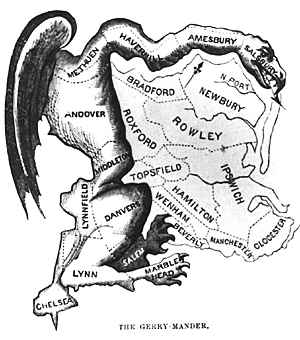
"The term gerrymandering is derived from Elbridge Gerry (1744-1814), the governor of Massachusetts from 1810 to 1812. In 1812, Governor Gerry signed a bill into law that redistricted his state to overwhelmingly benefit his party, the Republican Party. The opposition party, the Federalists, were quite upset. One of the congressional districts was shaped very strangely and, as the story goes, one Federalist remarked that the district looked like a salamander. No, said another Federalist, it's a gerrymander. The Boston Weekly Messenger brought the term gerrymander into common usage when it subsequently printed an editorial cartoon that showed the district in question with a monster's head, arms, and tail and named the creature a gerrymander."
Source: About.com
- Q: Does state legislation to end prison gerrymandering create the risk that the urban legislative districts would be unable to elect an African-American or Latino candidate?
- A: No. Despite the seemingly counter-productive addition of non-voting populations to those districts, legislation that would reallocate incarcerated people to their home addresses for redistricting purposes would not create a risk of urban districts being unable to elect African-American or Latino candidates.
This legislation provides the data necessary to account for the presence of incarcerated populations in the home communities: We'll know exactly how many people in any given district can't vote because they are incarcerated, and we'll know the race and ethnicity of the adjusted population for each block. In fact, compared to the estimates on citizenship and political turnout data that are currently used to evaluate how districts will actually perform, the data produced by the bill will be more precise. There is no risk that these districts will not perform as intended.
In fact, such legislation would likely help draw majority-minority districts in high-incarceration communities because properly crediting these districts with their true populations will make it easier to draw districts around their African-American or Latino cores.
Impact on funding
- Q: When states adjust Census population data for redistricting, is funding affected?
- A: There is no effect on the distribution of federal or state funds, because all funding programs have their own data sources that do not rely on redistricting data.
- Q: If the Census Bureau were to count incarcerated people at home, would funding be affected?
- A: No. While population does play a role in lots of funding formulas, incarcerated populations rarely make a difference.
How can two million incarcerated people not make a difference to the funding formulas? There are two reasons:- The majority of federal funding is in the form of block grants to states, so it does not matter where in any given state an incarcerated person is counted.
- Most other funding programs are quite sophisticated and the funding distributions are calculated in ways that directly or indirectly ignore prison populations. For example, federal funds intended for low-income schools are typically based not on the total population counted for the area but rather on the number of low-income children counted in the Census or the number of students in a school's discounted lunch program. Therefore, a large prison near a school would not increase funding to the school district.
Data
- Q: As a redistricting professional, how can I best access the Census Bureau's prison count data?
- A: In 2011 the Census Bureau published the Advance Group Quarters Summary File, which is still available in the original format through the Bureau. The 2020 PL 94-171 files contain a Group Quarters table (P5). This publication method essentially rolls the Advance Group Quarters Summary File into the PL files.
We have since, however, produced several easier ways to access this data, including a web-based county search tool, and a shapefile. Each of these contains the correctional populations by block. The web-based tool contains additional annotations (facility identification and in some cases basic demographic data) for each block with a correctional facility, as well as a link to the Census Bureau's facility footprints for the area. The shapefile contains data for all types group quarters, but includes links to our block-level annotations for the blocks that contain correctional facilities. - Q: As a redistricting professional, how can I know what correctional facilities are in particular Census Blocks?
- A: Each state's PL 94-171 redistricting data file from the Census includes block level counts of the group quarters population, but it will not distinguish between multiple correctional facilities counted in a single block, and where facilities were counted in neighboring blocks there may be some confusion as to which facility is which. Sometimes it's helpful to identify and be able to talk about a particular correctional population, for example, it might be helpful to distinguish a state prison from a federal prison or local jail counted block. For that reason, we annotate most of the blocks that contain correctional facilities with the facility name and type. Our annotations were drawn from comparisons with government surveys of federal prisons, state prisons, local jails and Indian Country jails. Our annotations are now available in the Correctional Facility Locator (2020) (additional annotations are added on a rolling basis.)
- Q: As a redistricting professional, how can I determine if prison gerrymandering — or a decision to avoid prison gerrymandering — impacts the voting rights of communities of color?
- A: In order to perform this analysis you need to know the race and ethnicity of the incarcerated population. Traditionally, redistricting professionals have had to estimate this data, but we've published the race and ethnicity of the correctional population for every Census Block that contains a correctional facility as counted by the U.S. Census. Previously, this data was unavailable because the Census Bureau doesn't publish this data in one table, but for the 2010 Census, we discovered that by comparing 5 separate tables we could derive 9 race and ethnicity categories for the reported incarcerated population for virtually every block. We published this race and ethnicity data — and identify the specific source tables — for each block with a correctional facility. This 2010 data is available in the block level results of our county search tool through the "detail" link in the right-hand column of your search results, and through links within the national group quarters 2010 shapefile. Unfortunately the Census Bureau is ceasing publication of some of these tables, so the data for 2020 is more limited but when available it is included in our 2020 shapefile. (Single-state versions of this shapefile are available through the Redistricting Data Hub.)
Recommended Reading:

About the Prison Policy Initiative
Learn more about the organization behind the Prison Gerrymandering Project.

The Racial Geography of Mass Incarceration
The transfer of Black and Latino incarcerated people to communities very different than their own is a nationwide problem.

How to get elected without being a candidate first.
Iowa Public Radio explores how Anamosa Iowa ended prison gerrymandering.
