In 2010 New York State enacted legislation to end prison gerrymandering. It was one of more than a dozen states that counted incarcerated people at home for redistricting purposes in the 2020 redistricting cycle.
New York - Campaign Archive
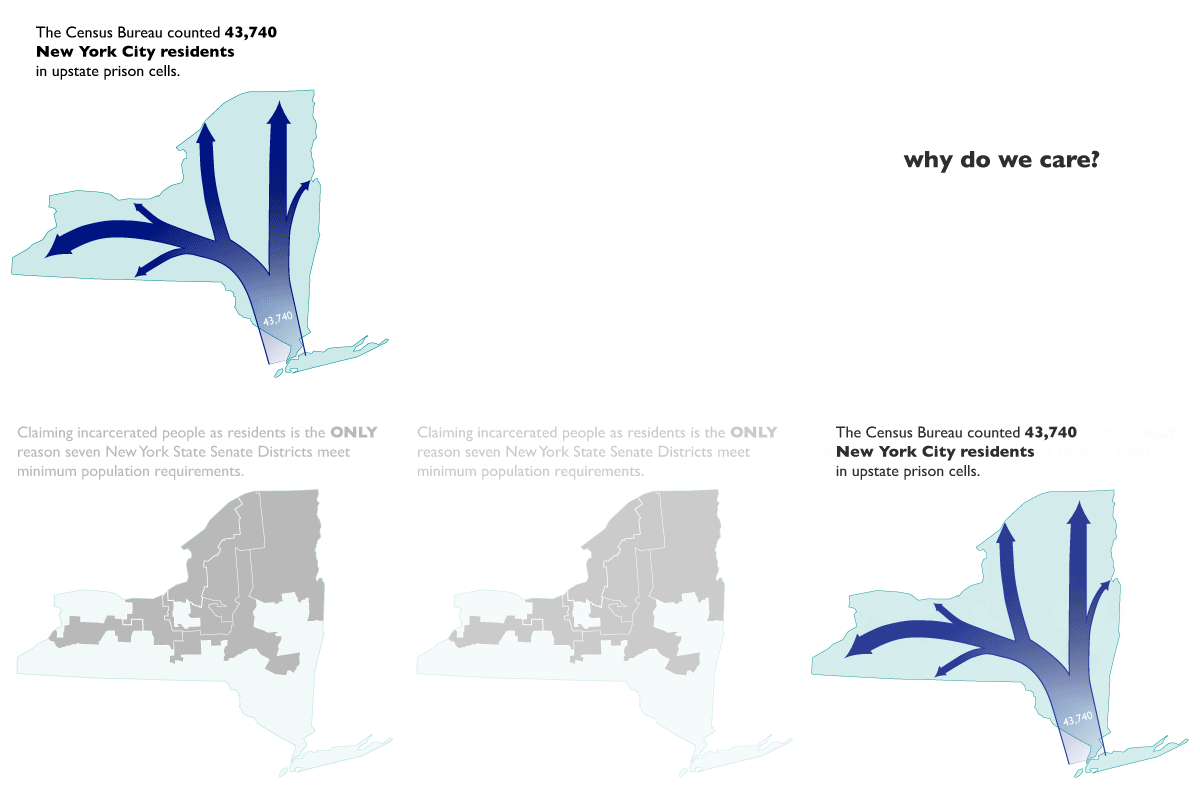
Animation by Adell Donaghue Design
The state legislature and some counties and municipalities have previously counted incarcerated people as residents of the prison location, inflating the local population counts used for legislative districts. Padding legislative districts with prison populations artificially enhances the voice of people in those districts at the expense of all districts that do not contain a prison.
The new law uses data from the Department of Corrections to identify the home addresses of incarcerated persons and include them in the population counts for those areas prior to redistricting. Because the law does not change the core Census data, no federal funding based on Census data is affected. The bill ensures that state senate, state assembly, county and municipal redistricting in the state is not undermined by prison gerrymandering.
The law puts all state and local districting in New York in line with the practice of 13 rural New York counties with large prisons that conduct their own adjustments to census data to avoid prison-based gerrymandering.
July 2012 update: Some legislators with large prisons in their districts unsuccessfully sued to bring back prison-based gerrymandering. For more on the lawsuit, please see our Little v. LATFOR page.
Legislation passed!
New York passed a law to collect the home addresses of incarcerated people, and to require the state and county governments to draw legislature districts on the basis of Census Bureau data corrected to count incarcerated people at their home addresses. The bill to end prison-based gerrymandering was attached as part XX of the revenue budget (A9710D/S6610C) and had a technical amendment, A11597/S8415. The Bill and the amendment passed the Assembly on July 1, and the Senate on August 3, and signed into law by the Governor on August 12, 2010.
See the statements upon passage from the Prison Policy Initiative and Demos, New York's Coalition to End Prison-Based Gerrymandering, NYCLU and Common Cause NY, and the NAACP LDF and Brennan Center for Justice.
New York area leaders
It’s impossible to include everyone who contributed to abolishing prison gerrymandering in New York, but if you are looking to get involved, these are some of the people and organizations you might want to contact:
- State Senator Eric Schneiderman, sponsor of S6725, which requires that redistricting be based on corrected census data that counts incarcerated people at their address of residence.
- Jeremy Saunders and Sean Barry at New York City Aids Housing Network
- Steve Carbo at Demos
- Cleo Oliver at Public Policy and Education Fund of New York
- Monifa Bandele at the Praxis Project
- Erika Wood at the Brennan Center for Justice (See her memorandum in support of the legislation.)
Endorsements
- “The city supports a change in the residency rule for prisoners in the 2010 Census from the address of the institution where they are incarcerated to the last known permanent residence prior to incarceration,” Marc LaVorgna, a spokesman for New York City Mayor Bloomberg (I) told the Washington Post in April 2009.
- “We should not count prisoners as a political base for legislators who do not honestly represent them and for whom they did not vote. In other words, remove the partisan politics and secure the integrity of legislative decisions…” wrote Andrew M. Cuomo in “Prison Inmates, Republican Constituents,” Times Union, Albany in January 2005.
- The New York Times editorial board has supported this movement with over 12 editorials, including Phantom Voters in New York, Prison-Based Gerrymandering, and Phantom Voters, Thanks to the Census.
-
In new Census, home is where the vote should be Times Herald-Record, Editorial, February 19, 2010 (Orange County, NY):
"... a politician should be embarrassed to claim that people held in prisons should count as constituents."
-
Legislation would stop 'prison-based gerrymandering', Syracuse Post-Standard Editorial, February 24, 2010 (Cayuga County):
"We think the proposal deserves quick passage as the state prepares to redraw all the Senate and Assembly districts in 2012."
-
Don't count prisoners with voters, Utica Observer-Dispatch Editorial, February 26, 2010 (Oneida County, NY):
"Wagner says there are two bills pending in the state Assembly and Senate that would require the state to distribute adjusted counts for county use in redistricting. It would make sense for Sen. Joseph Griffo, R-Rome, and Assemblywoman RoAnn Destito, D-Rome, to get behind such legislation."
- Organizational endorsers include:
- AIDS Community Services of Western New York
- CAAAV Organizing Asian Communities
- Citizens Union
- Community Voices Heard
- Families United for Racial and Economic Equality
- Family Services Network of New York
- Lower East Side Harm Reduction Center
- Make the Road New York
- Mothers on the Move/Madres en Movimiento
- NYC AIDS Housing Network
- New York Harm Reduction Educators
- Positive Health Project, Inc.
- The Foundation for Research on Sexually Transmitted Diseases, Inc.
- Urban League of Westchester County, Inc.
- Washington Heights CORNER Project
Fact sheets
- 13 New York Counties Reject Prison-Based Gerrymandering [PDF]
- A Prison Is Not A Home: The Lesson Of People v. Cady (and direct link [PDF])
- Prison-Based Gerrymandering in St. Lawrence County [PDF]
- Prison-Based Gerrymandering in Chautauqua County [PDF]
- Prison-Based Gerrymandering in Erie County [PDF]
- Prison-Based Gerrymandering in Jefferson County [PDF]
- Prison-Based Gerrymandering in Livingston County [PDF]
- Prison-Based Gerrymandering in Oneida County [PDF]
- Prison-Based Gerrymandering in Madison County [PDF]
- Prison-Based Gerrymandering in Wayne County [PDF]
- New York’s Census Adjustment Act [PDF]
- Three trends in New York that require a changed Census [PDF]
- Prison district profile: Senate District 45: Betty Little [PDF]
- The Census Bureau’s prison miscount: It’s about political power, not funding [PDF]
- Prison-Based Gerrymandering in the City of Elmira [PDF]
- Prison-Based Gerrymandering in the City of Rome [PDF]
- Incarcerated people are transported to rural prisons, but remain residents of their home communities [PDF]
- Why our opponents should support ending prison-based gerrymandering in New York State [PDF]
- End Prison-Based Gerrymandering [PDF], by the Public Policy and Education Fund of New York
Posters
- Most upstate counties with prisons agree: A prison cell is not a residence [PDF]
Additional reading
- Democracy reform is not a partisan horse race, by Peter Wagner, August 11, 2010.
- Importing Constituents: Prisoners and Political Clout in New York (2002) is our district-by-district analysis of how crediting New York City’s incarcerated residents to upstate districts distorts democracy and violates the federal and state constitutions.
- Phantom constituents in the Empire State: How outdated Census Bureau methodology burdens New York counties examines how rural counties with prisons draw their districts. We found:
- Most of New York’s rural counties with large prisons reject the Census and fairly apportion political power within the county on the basis of actual — not prison — populations.
- There are 5 counties with a district where at least 20% of its population is derived from prisoners.
- Brief Amici Curiae In Support Of Plaintiff-Appellant Jalil Abdul Muntaqim, a/k/a/ Anthony Bottom, Urging Reversal Of The District Court (2005) is a friend of the court brief submitted to the U.S. Court of Appeals for the Second Circuit by the National Voting Rights Institute (Demos) and the Prison Policy Initiative. The brief puts prison-based gerrymandering in the context of other forms of racially based election practices in the state.
- Peter Wagner's testimony before the New York State Legislative Task Force on Demographic Research and Reapportionment, March 14, 2002. Prepared testimony: in HTML or PDF format. Or read the Transcript
Recommended Reading:

About the Prison Policy Initiative
Learn more about the organization behind the Prison Gerrymandering Project.

The Racial Geography of Mass Incarceration
The transfer of Black and Latino incarcerated people to communities very different than their own is a nationwide problem.

The Census Bureau's Miscount: It's about representation, not funding
We explain that prison gerrymandering is bad for democracy but federal & state aid are not impacted.

Prison-based Gerrymandering in Anamosa, Iowa
How a prison helped one man get elected with just two votes.