Ending the Prison Windfall — New York Times editorial
by New York Times, January 17, 2007
Link
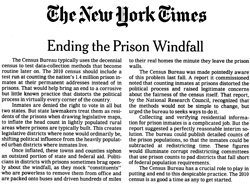
The Census Bureau typically uses the decennial census to test data-collection methods that become routine later on. The 2010 census should include a test run at counting the nation’s 1.4 million prison inmates at their permanent addresses instead of in prisons. That would help bring an end to a corrosive but little known practice that distorts the political process in virtually every corner of the country.
Inmates are denied the right to vote in all but two states. But state lawmakers treat them as residents of the prisons when drawing legislative maps, to inflate the head count in lightly populated rural areas where prisons are typically built. This creates legislative districts where none would ordinarily be, shifting political influence from the heavily populated urban districts where inmates live.
Once inflated, these towns and counties siphon an outsized portion of state and federal aid. Politicians in districts with prisons sometimes brag openly about the windfall, as they mock “constituents” who are powerless to remove them from office and are packed onto buses and driven hundreds of miles to their real homes the minute they leave the prison walls.
The Census Bureau was made pointedly aware of this problem last fall. A report it commissioned noted that counting inmates at prisons distorted the political process and raised legitimate concerns about the fairness of the census itself. That report, by the National Research Council, recognized that the methods would not be simple to change, but urged the bureau to seeks ways to do it.
Collecting and verifying residential information for prison inmates is a complicated job. But the report suggested a perfectly reasonable interim solution. The bureau could publish detailed counts of the prison populations, so that the inmates could be subtracted at redistricting time. These figures would illuminate corrupt redistricting committees that use prison counts to pad districts that fall short of federal population requirements.
The Census Bureau has a crucial role to play in putting and end to this despicable practice. The 2010 census is as good a time as any to get started.
New article from Northwestern University Law School demonstrates viability of state-based solution to federal failures in decennial census
by Peter Wagner, January 3, 2007
Link
FOR IMMEDIATE RELEASE —
Every decade, the Census Bureau counts tens of thousands of Chicagoans incarcerated in state prisons as if they were part of downstate communities, diluting the votes of Chicagoans and distorting how Illinois draws its legislative districts. The next census is less than four years away, and the Census Bureau is resisting calls to start counting prisoners as residents of their legal home addresses.
States are not powerless victims of this misguided census enumeration policy, however, points out a new article in Northwestern University’s prestigious Journal of Criminal Law and Criminology. Instead, Illinois and other states may legally apportion citizens to reflect their true legal residence rather than the misleading usual residence employed by the Census Bureau.
“Counted out Twice — Power, Representation & the ‘Usual Residence Rule’ in the Enumeration of Prisoners: A State-based Approach to Correcting Flawed Census Data,” by recently graduated Northwestern University School of Law student David Hamsher documents how populations of Chicago and other urban areas are undercounted, while rural areas which have lured prison facilities as job generators find their population over-counted.
While the simplest solution would be for the Census Bureau to start counting prisoners as residents of their home addresses, the Census Bureau has thus far resisted calls to change their enumeration procedures. Given this resistance, legislators in Illinois and New York State have introduced legislation to ensure that apportionment is based on a more accurate reflection of their population. “If the Census Bureau fails to fix its counting procedures before the 2010 Census, my article shows that Illinois and every other state has a very appropriate and viable solution”, said Hamsher.
In Illinois, Representative Arthur L. Turner has proposed adjusting the federal census to reflect the legal residence of all Illinois citizens, not just their usual residence. “Rep. Turner’s bill is a creative solution to a big problem that the Census Bureau has created for democracy in Illinois and around the nation,” says Peter Wagner of the Prison Policy Initiative, a national expert on prisoner enumeration issues.
Hamsher’s article is the first in-depth look at the legality of legislation intended to correct the Census Bureau’s flawed enumeration method. It provides the legal foundation necessary for legislators to support state-based solutions to federal failures. According to Wagner, “David’s article highlights the unfairness of present policy, shows the power of states to fix flawed Census data, and provides an important legal underpinning to an emerging solution.”
Founded in 1910, the Journal of Criminal Law and Criminology, published by Northwestern University School of Law is the second most widely subscribed journal published by any law school in the country.
The article is available at http://www.davidhamsher.com/
Contact:
David Hamsher, dhamsher@yahoo.com, 314.249.1268
Peter Wagner, Prison Policy Initiative, 413 527 1333
