by New York Times,
September 18, 2006
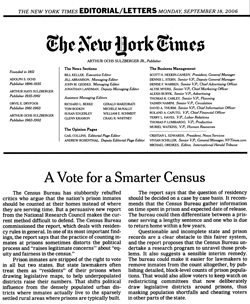 The Census Bureau has stubbornly rebuffed critics who argue that the nation’s prison inmates should be counted at their homes instead of where they are serving time. But a persuasive new report from the National Research Council makes the current method difficult to defend. The Census Bureau commissioned the report, which deals with residency rules in general. In one of its most important findings, the report says that the practice of counting inmates at prisons sometimes distorts the political process and “raises legitimate concerns” about “equity and fairness in the census.”
Prison inmates are stripped of the right to vote in all but two states. But state lawmakers often treat them as “residents” of their prisons when drawing legislative maps, to help underpopulated districts raise their numbers. That shifts political influence from the densely populated urban districts where inmates actually live to the sparsely settled rural areas where prisons are typically built.
The report says that the question of residency should be decided on a case by case basis. It recommends that the Census Bureau gather information on time spent in prison and expected date of release. The bureau could then differentiate between a prisoner serving a lengthy sentence and one who is due to return home within a few years.
Questionable and incomplete state and prison records are a clear obstacle to this fairer system, and the report proposes that the Census Bureau undertake a research program to unravel those problems. It also suggests a sensible interim remedy. The bureau could make it easier for lawmakers to remove inmates from the count altogether, by publishing detailed, block-level counts of prison populations. That would also allow voters to keep watch on redistricting committees that now deliberately draw legislative districts around prisons, thus masking population shortfalls and cheating voters in other parts of the state.
National Academies releases report calling for the Census Bureau to begin collecting the home addresses of incarcerated people.
September 14, 2006
September 14 — The National Research Council of the National Academies today released a report calling for the Census Bureau to begin collecting the home addresses of people in prison and to study whether this alternative address should be used in the Census. The report, authored by leading demographers, statisticians and sociologists, was commissioned by the Census Bureau to reexamine where people should be counted in the Census.
Continue reading →
by Peter Wagner,
September 8, 2006
A new website is asking candidates for Governor, Lieutenant Governor, Attorney General, and Comptroller in New York for their position on census reform and 5 other critical issues. After this Tuesday’s primary, the website, www.BetterBallotsNY.org, will expand to include a number of State Senate and State Assembly races around New York State.
The website provides information about each elected office and provides short answers from the candidates to these 6 questions of importance to the communities that are typically underrepresented at the polls:
- What are your views on Election Day registration in New York State?
- What are your views on people in prison or on parole voting in New York State?
- What are your views on the U.S. Census Bureau’s method of assigning residence to incarcerated people?
- What are your views on the Rockefeller Drug Laws?
- How should the state or federal government address reentry for people who have completed their sentences and are seeking employment and/or housing?
- What are your views on this contract between Verizon/MCI and the New York State Department of Correctional Services?
Better Ballots was launched by the Voter Enfranchisement Project in partnership with the Drop the Rock Coalition, the New York Campaign for Telephone Justice, and the Prison Policy Initiative in order to increase civic participation, especially in communities that are disproportionately impacted by the criminal justice system.
“I believe that infrequent voters and new voters are more likely to vote when they learn where candidates stand on issues such as Election Day Registration, the Rockefeller Drug Laws, and the exclusive contract between Verizon/MCI and the New York State Department of Correctional Services,” said project director Maggie Williams.
“Better Ballots is valuable because it helps voters determine who is running for which positions and learn where the candidates stand on critical issues. Centralizing this information in one place empowers New York voters and makes our democracy more accountable to all communities,” she continued.
 The Census Bureau has stubbornly rebuffed critics who argue that the nation’s prison inmates should be counted at their homes instead of where they are serving time. But a persuasive new report from the National Research Council makes the current method difficult to defend. The Census Bureau commissioned the report, which deals with residency rules in general. In one of its most important findings, the report says that the practice of counting inmates at prisons sometimes distorts the political process and “raises legitimate concerns” about “equity and fairness in the census.”


