by Peter Wagner,
September 27, 2004
Drake Bennett has written an excellent profile of the Census issue in the Boston Sunday Globe Ideas section. The piece ties together the harm to democracy in both urban and rural communities from the Census Bureau’s practice of counting prisoners as residents of the prison town and makes all of the necessary connections to larger issues.
As the Boston Globe article may disappear over time, I’ve permanently archived it on the Prison Policy Initiative website:
Head count: The Census counts prisoners as residents of the towns where they’re incarcerated. One crusading lawyer from Northampton thinks this little clerical matter is a big problem for American democracy.
by Peter Wagner,
September 20, 2004
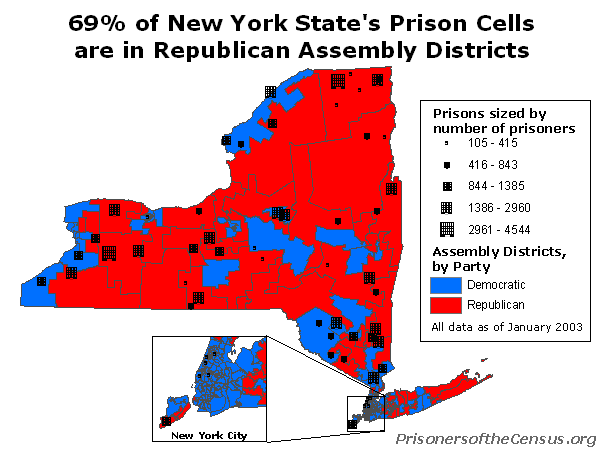
New York State is a majority Democratic state, but the politics — like the prisons and prisoners — are far from evenly distributed throughout the state. The Republican party controls only 1 in 3 New York State Assembly Districts, mostly in the state’s sparsely populated upstate region.
While the majority of the state’s prisoners come from heavily Democratic New York City, they are disproportionately incarcerated in Republican Assembly Districts. As of January 2003, 69% of the state’s prison cells are in Assembly Districts represented by Republicans.
by Peter Wagner,
September 13, 2004
A Government Accounting Office report [PDF] released on September 14 concluded that it would not be feasible for the Census Bureau to count overseas Americans in the 2010 Census. The report is based on a review of the Census Bureau’s recently concluded test enumeration of Americans in Kuwait, Mexico and France. The issue is relevant as an example of how other special populations are counted in the U.S. Census. While U.S. government employees overseas have typically been counted, other groups of Americans have generally — but not always — been excluded.
When the test enumeration began in February, I wrote a column comparing the merits and history of counting overseas Americans with the issue of changing how prisoners are counted. I noted that the Census Bureau’s rules seemed to track the number of people abroad. When war meant large numbers of Americans in other countries, there was an increased relevancy in counting them. When the numbers declined, so did the relevancy of the count. I argued that the rapid increase in the size of the incarcerated population creates an urgency to reexamine how the Census Bureau’s residency rules count prisoners.
The GAO report focused on another issue previewed in the February column: Overseas Americans are hard to locate. Americans overseas are not required to register their locations with the State Department or local governments, so there is no master list of overseas Americans to send forms to.
Continue reading →
by Peter Wagner,
September 8, 2004
Emily Bazelon and I have an op-ed in the September 8, 2004 Newsday calling for the Census Bureau to change how it counts prisoners: Census’ cell count steals voting power.
by Peter Wagner,
September 6, 2004
This fact of the week is a letter written by 3 residents of Franklin County in upstate New York to the Census Bureau describing how rural New York counties with prisons would benefit from a Census Bureau decision to stop counting prisoners as residents of the prison town. The letter chronicles “unnecessary controversy and confusion” as rural residents react to flawed Census data that would distort how political power is distributed among county residents.
Continue reading →