by Peter Wagner,
July 26, 2004
Our project, Prisoners of the Census, addresses the political impact of the Census Bureau’s policy of counting prisoners where they are incarcerated, not at home. In some cases, a large population is transferred to prison towns, but the potential impact of prisoner miscount can be large even when the number of prisoners transferred is small.
This example will illustrate how small changes in district boundary lines – even without errors in the underlying Census data — can determine which party or group controls the government. If the underlying Census data is distorted, the potential impact could be far larger.
Continue reading →
by Peter Wagner,
July 19, 2004
As I wrote in May, there are 3 ways to fix how the U.S. Census counts prisoners:
- The Census could change its methodology
- States could adjust the counts after the fact
- States can ignore the federal Census and bring back their state Censuses.
The first option is the best, but the others are far more practical than they may sound at first glance. One state already does something quite similar: Kansas adjusts how students and the military are counted.
In 2001, Texas Representative Harold Dutton introduced a bill to restore Texas prisoners to their home addresses prior to redistricting. Although the bill was not ultimately successful, the bill was approved by the Elections committee and does illustrate one approach that could be taken by states if the Census Bureau does not change its policy.
The bill would have required the operators of all public and private prisons in Texas to submit to the Texas Controller a report containing the name, age, gender, ethnicity and pre-incarceration address of each person counted in the Census as a resident of the prison. The Controller would then deduct these persons from the Census tracts with the prisons and restore them to their home Census tracts.
Continue reading →
by Peter Wagner,
July 12, 2004
As described in last week’s column, how the Census Bureau counts prisoners undercounts Ohio’s urban areas while boosting the population of the rural areas that host the prisons. Also skewed is how much representation each region receives in the state legislature, because Ohio relies on Census Bureau data to redraw its state legislative boundaries
States are required to redraw their legislative boundaries each decade so that each will contain the same number of people as required by the 14th Amendment’s One Person One Vote principle. Equally sized districts ensure that each resident has an equal access to government regardless of where she or he lives.
The Census counts everyone including people who can’t vote such as prisoners and children. But children are at least a part of the surrounding community and share some common interests with it. Children can with some confidence rely on their neighboring adults to represent their interests. But prison communities are often very closely aligned with the prison industry and are likely to be quite dissimilar to the communities that the prisoners came from.
So while prisoners are barred from voting for or against the legislator that “represents” them while they are incarcerated, Ohio restores a prisoner’s right to vote on the day that he or she is released. But that is also the same day that the former prisoner will be getting on a bus to leave the prison district and return back home.
Continue reading →
by Peter Wagner,
July 5, 2004
The Census Bureau counts prisoners not at their homes but as if they were residents of the town that contained the prison. This administrative quirk reduces the population of the urban communities where most prisoners originate and swells the population of the rural communities that house prisons. Ohio now incarcerates more than 3 times as many people as it did as recently as 1980, making what would once be a trivial issue into a critical one.
Urban areas suffer, prison counties gain
All of Ohio’s major cities see a reduction in their Census population from how prisoners are counted. Although there are small state prison facilities in Cuyahoga County (Cleveland) Montgomery County (Dayton) and Franklin County (Columbus) the small gain is overshadowed by the loss. Cuyahoga County has 11,167 residents in prison with 10,441 incarcerated in other counties. The Census shows Hamilton County with 5,235 fewer people. This population is instead credited to the counties that contain the prisons. Pickaway County has a Census population of 53,437, but 5,583 of those people are actually prisoners from other parts of the state.
Thankfully, Census Bureau policy on how to count the population is not fixed, instead it responds to changing needs. When evolving demographics meant more college students studying far from home and more Americans living overseas, the Census policy changed in order to more accurately reflect how many Americans were living where. Today, the growth in the prisoner population requires the Census to update its methodology again. Otherwise, Ohio’s urban communities are going to find themselves shortchanged in the 2010 Census.
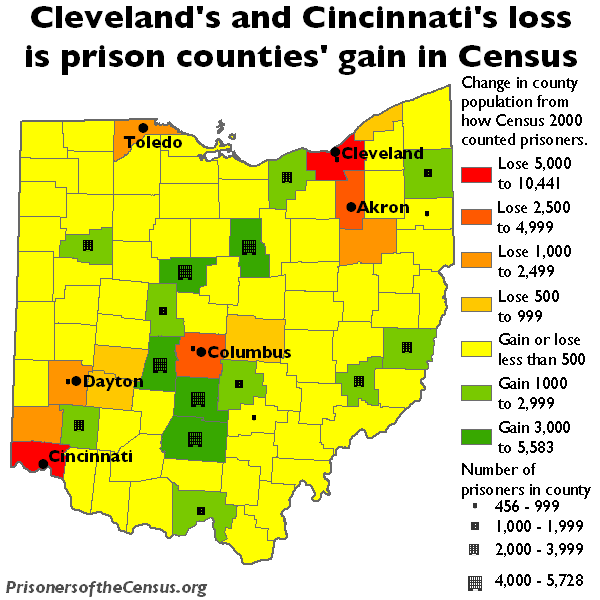
Figure 1. Ohio’s largest cities lose sizable population to a Census Bureau quirk that counts the incarcerated as if they lived in their remote prison cells.
Source: Peter Wagner and Rose Heyer Importing Constituents: Prisoners and Political Clout in Ohio


