by Peter Wagner,
August 25, 2003
Almost 30 percent of new residents who came to Upstate New York in the 1990s didn’t make the trip by choice, and they didn’t move into subdivisions or houses on secluded cul-de-sacs. They were inmates making their new homes in prison cells, according to a new report on population trends in upstate.
–Gannet News Service, August 24, 2003
That was perhaps the most striking statistic in a new report by the Brookings Institution documenting the stagnation of much of upstate, which grew in population just 1.1 percent in the ’90s.
Counting prisoners in their home community would avoid this type of confusion that skews Census statistics.
See our New York maps showing how counting urban prisoners as residents of rural prison towns undermines the accuracy and utilitity of Census data.
by Peter Wagner,
August 18, 2003
The Federal Constitution does not prohibit a state from adjusting the census data to count population as it wishes the prisoners to be counted:
“Although a state is entitled to the number of representatives in the House of Representatives as determined by the federal census, it is not required to use these census figures as a basis for apportioning its own legislature. (Borough of Bethel Park v Stans, 449 F.2d 575 (3rd Cir. 1971)
When the 2000 Census made mistakes and counted some prisons in empty fields or in the middle of the Hudson River, New York corrected its Census-based redistricting data by “moving” the prisons back to their actual locations. A special state census of all residents would be one way to accurately count the population of prisoners at their legal residences. Alternatively, a state could adjust the federal Census data to transfer each prisoner’s Census count from the prison town to his or her legal residence.
by Peter Wagner,
August 11, 2003
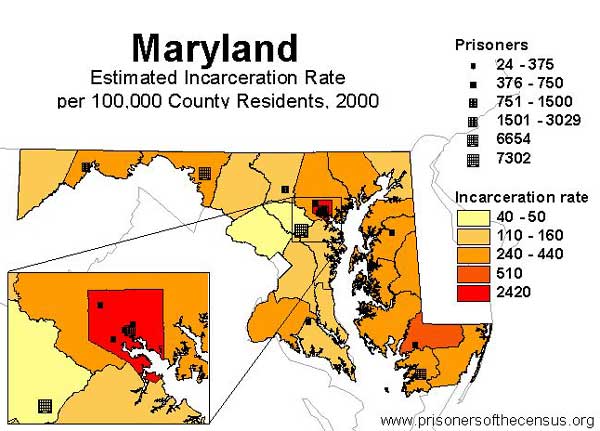
There is a tremendous disparity in Maryland between the incarceration rates in each county. Baltimore City’s incarceration rate of 2,420 per 100,000 residents may be the highest incarceration rate of a city in the country. (By comparison, in 1950 the Soviet gulags held 1,423 prisoners per 100,000 residents.) Although the bulk of the prisoners come from Baltimore City, most of the prisons are constructed far from the city.
The enumeration of prisoners from Baltimore as if they were residents of these prison communities decreases the political power of Baltimore and increases that of the prison regions. As a result, Baltimore does not get the legislative attention it so desperately needs.
by Peter Wagner,
August 4, 2003
As the following two letters to the editor show, counting prisoners as residents of the prison town can present an image of rapid growth or tumultuous decline, when in fact nothing has really changed:
Dear Editor, Youngstown Vindicator According to your recent article “Valleys are still losing people” almost half of the population lost in Mahoning County since Census 2000 is “misleading and explainable” due to the closure of a private prison in Youngstown. The purpose of the census is to count residents in each community, so those prisoners should never have been counted at the prison in the first place. When a community reports a large decline in population, it looks unattractive for potential development. The Census could protect our communities from artificial swings in population if they counted prisoners at home and not in temporary prisons. Peter Wagner, Prison Reform Advocacy Center Cincinnati, OH July 16, 2003
Dear Editor, Birmingham NewsYour article “Brent is booming, behind iron bars” (July 18) reports all of the town’s reported population increase was the result of an increase in the prison population at the Bibb County Correctional Facility. Alabama’s second fastest growing town is, well, not actually growing. According to the Alabama Department of Corrections, only a few of the prisoners at the Bibb County prison are from Bibb County. But the 1,800 prisoners are more than 8% of the county’s population. The purpose of the Census is to reflect the size, strengths and needs of our communities. It would make more sense for the Census to count prisoners at home rather than pretend they lived as permanent residents of the prison town. Peter Wagner, Cincinnati OH July 18, 2003



